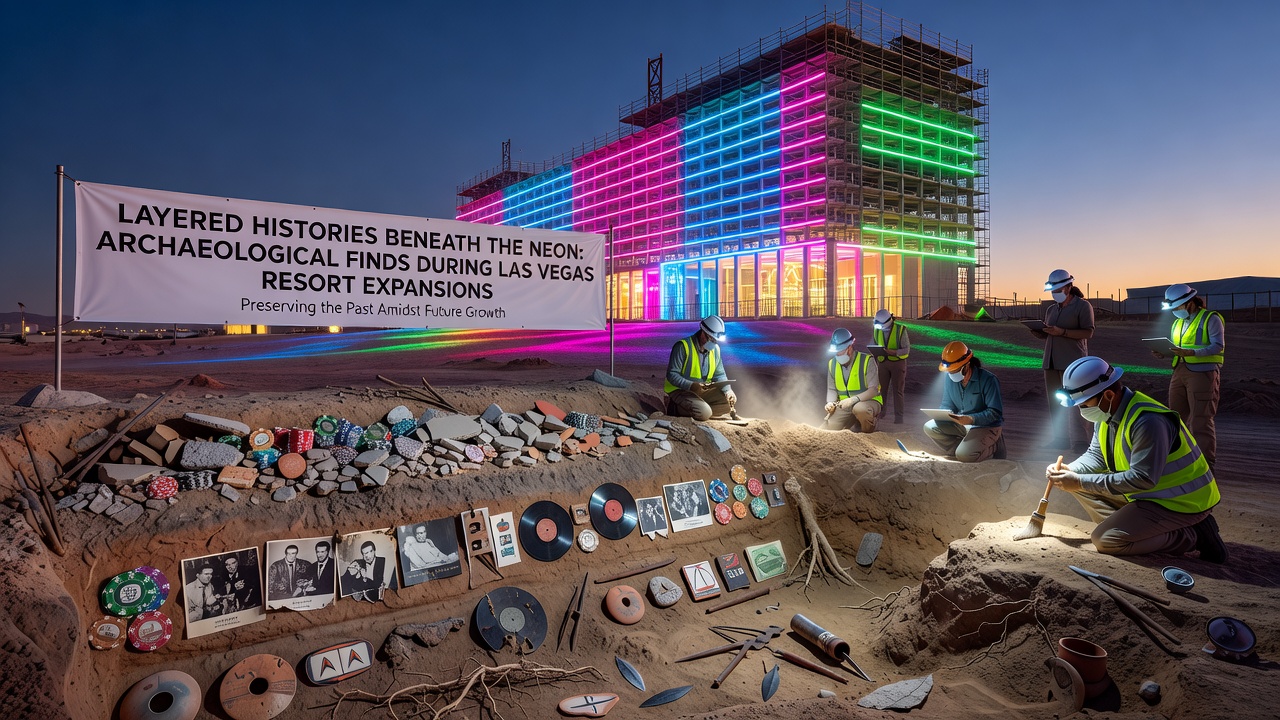
Layered Histories Beneath the Neon: Archaeological Finds During Las Vegas Resort Expansions
Las Vegas resort expansions regularly intersect with buried cultural layers that date back millennia, and construction teams have documented everything from Southern Paiute tool scatters to early 20th-century railroad camps since the 1990s. Nevada state law requires cultural resource surveys before any major ground disturbance, so developers coordinate with archaeologists who monitor grading and trenching operations in real time. Those surveys have produced thousands of artifacts that now reside in state repositories and university collections.
Prehistoric Sites Beneath the Strip
Evidence of human occupation in the Las Vegas Valley extends at least 10,000 years, and resort projects along Las Vegas Boulevard have repeatedly exposed lithic scatters and hearth features associated with Paleoarchaic and Archaic periods. During the 2004-2006 expansion of a major property near the center of the Strip, crews recovered projectile points, ground stone fragments, and faunal remains that researchers linked to seasonal camps along ancient lake margins. Similar materials surfaced again in 2018 when a new tower foundation was excavated a few blocks south, prompting a controlled data-recovery program that lasted six months and yielded more than 4,000 catalogued items.
Historic-Era Discoveries and Railroad Infrastructure
Nineteenth-century transportation corridors left durable traces under modern resort footprints. The San Pedro, Los Angeles and Salt Lake Railroad alignment, completed in 1905, crossed what is now prime Strip real estate, and expansion work in the late 1990s uncovered sections of track bed, telegraph poles, and worker housing foundations. More recent projects have revealed Chinese immigrant labor camps tied to that same rail line, complete with ceramic tableware and opium pipe fragments that provide material evidence of daily life in those communities. State historic preservation officers review each find and decide whether preservation in place or systematic excavation offers the better mitigation strategy.
Regulatory Framework and Monitoring Protocols
The Nevada State Historic Preservation Office maintains oversight of all projects that receive federal permits or funding, while the Bureau of Land Management applies similar standards on adjacent federal parcels. Bureau of Land Management cultural resources guidance requires predictive modeling before fieldwork begins, and contractors must employ qualified archaeologists who can halt operations within minutes if intact deposits appear. In August 2026, monitoring teams working on a north-Strip resort addition paused excavation for eleven days after a buried hearth and associated pottery sherds were identified; the pause allowed rapid documentation and sampling before construction resumed under an approved treatment plan.
Those who've studied the cumulative record note that finds cluster along former stream channels and old lake shorelines, which helps planners refine their sensitivity maps for future developments. Data from more than thirty monitored projects since 2000 now feed into a geographic information system maintained by the state, allowing subsequent surveys to target high-probability zones with greater precision.
Case Studies from Recent Expansions
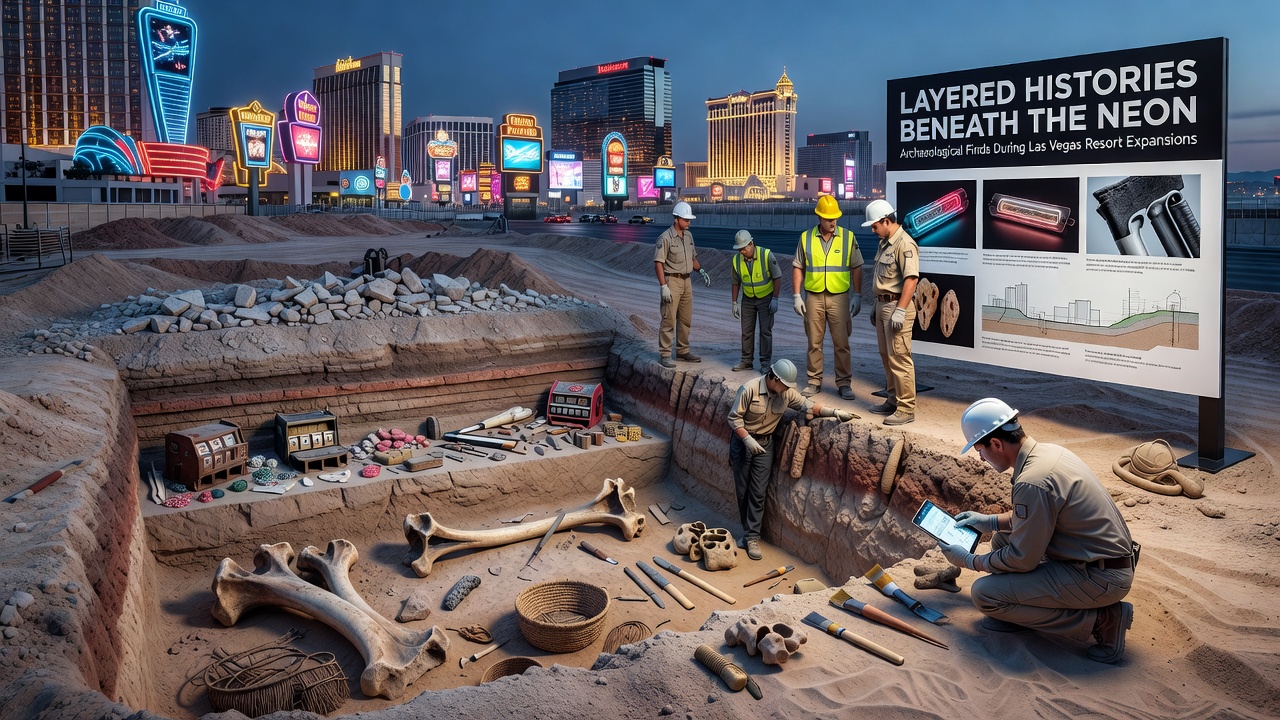
One high-profile example occurred during site preparation for a new entertainment district component in 2023. Archaeologists documented a dense scatter of obsidian flakes and a single Clovis-style point roughly two meters below current grade, indicating repeated use of the area during the terminal Pleistocene. Another project, tied to a 2025 tower renovation, exposed a segment of the old Las Vegas Creek channel that contained both prehistoric fish bones and historic-period bottles from a 1930s roadside camp. Each case followed the same sequence: discovery, notification to regulators, consultation with affiliated tribes, and either preservation or controlled recovery followed by public reporting.
Public Interpretation and Research Outcomes
Artifacts recovered during these projects rarely stay on display in resort lobbies, yet several properties have incorporated interpretive panels that summarize the archaeological record without disclosing sensitive site locations. University of Nevada, Las Vegas researchers have published peer-reviewed articles on the lithic assemblages, and the resulting datasets contribute to broader studies of Great Basin mobility patterns. University of Nevada Las Vegas archaeology reports show that the cumulative sample now exceeds 150,000 artifacts, most of them debitage and ground stone rather than diagnostic pieces, yet the sheer volume allows statistical analysis of raw-material procurement and reduction strategies across time.
Conclusion
Resort expansion therefore functions as both economic driver and inadvertent research engine, bringing systematic archaeological attention to parcels that might otherwise remain unexamined. Continued coordination between developers, state agencies, and tribal representatives ensures that new discoveries are documented and studied even as the city continues to grow upward and outward. The layered record beneath the neon continues to accumulate data that refines understanding of long-term human presence in the Mojave Desert.