The Silent Systems: How Las Vegas Resorts Manage Water Recycling for Their Expansive Pool and Fountain Features
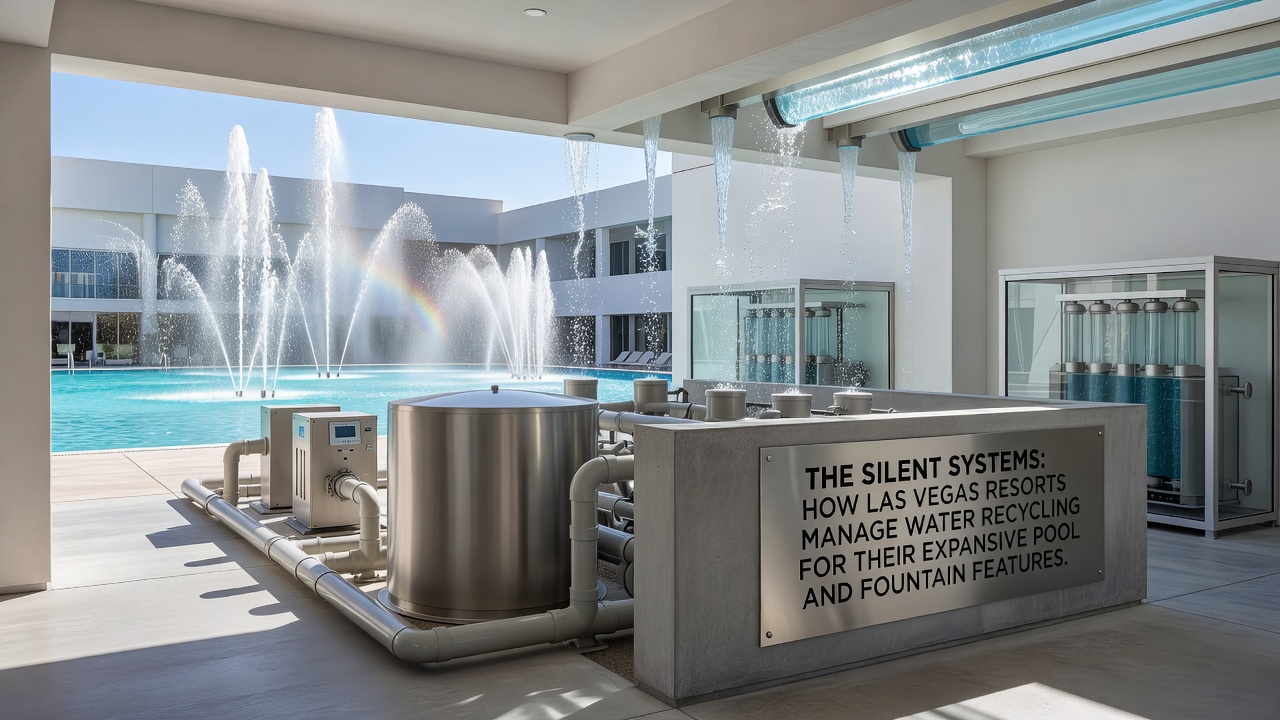
Las Vegas resorts operate extensive water recycling networks that support massive pool complexes and choreographed fountain displays in an arid environment where annual rainfall averages just over four inches. These systems capture, treat, and reuse water continuously rather than drawing fresh supplies from the municipal grid for every cycle, and operators balance evaporation losses with advanced filtration stages that remove particulates, organics, and minerals before the water returns to its original use. Data from regional authorities shows that large properties recycle between 70 and 90 percent of their pool and fountain volumes daily, a figure achieved through layered treatment trains that combine mechanical filtration, ultraviolet disinfection, and chemical balancing. Engineers design the infrastructure so that backwash from pool filters feeds directly into sedimentation basins where solids settle out, then the clarified liquid moves through multimedia filters and cartridge units before ultraviolet reactors neutralize pathogens. Fountain systems follow similar loops yet incorporate additional ozone injection to maintain clarity during high-velocity aerial displays that expose water to airborne contaminants. Resorts coordinate these processes through centralized building management platforms that monitor turbidity, pH, and oxidation-reduction potential in real time, adjusting chemical feeds automatically to stay within health-code parameters set by Clark County.Treatment Trains and Closed-Loop Designs
Closed-loop configurations dominate newer installations because they minimize both consumption and discharge volumes, while older properties have retrofitted existing equipment to achieve comparable recovery rates. Sand filters capture larger debris from pool circulation, and the resulting backwash slurry undergoes dissolved-air flotation before the recovered water rejoins the main loop. Resorts schedule filter maintenance during overnight hours when guest activity is lowest, allowing technicians to isolate sections without interrupting daytime operations. Ozone generators sized for peak fountain throughput produce on-site gas that oxidizes organic compounds and reduces the need for chlorine residuals, which in turn lowers total dissolved solids that would otherwise accumulate and require periodic dilution.
Regulatory Framework and Reporting Requirements
Nevada statutes require quarterly reporting of recycled volumes and discharge events to the Southern Nevada Water Authority, which tracks cumulative consumption across the Las Vegas Valley. Properties must maintain dual-plumbing separation between potable and non-potable lines, and inspectors verify cross-connection controls during annual permitting renewals. As preparations advance for June 2026, updated guidelines from the Nevada Division of Environmental Protection will introduce stricter limits on total dissolved solids in fountain discharge, prompting several resorts to install additional reverse-osmosis polishing stages ahead of the deadline. Those upgrades build on existing microfiltration membranes that already achieve 95 percent recovery before any water leaves the property boundary.
Evaporation Management and Makeup Strategies
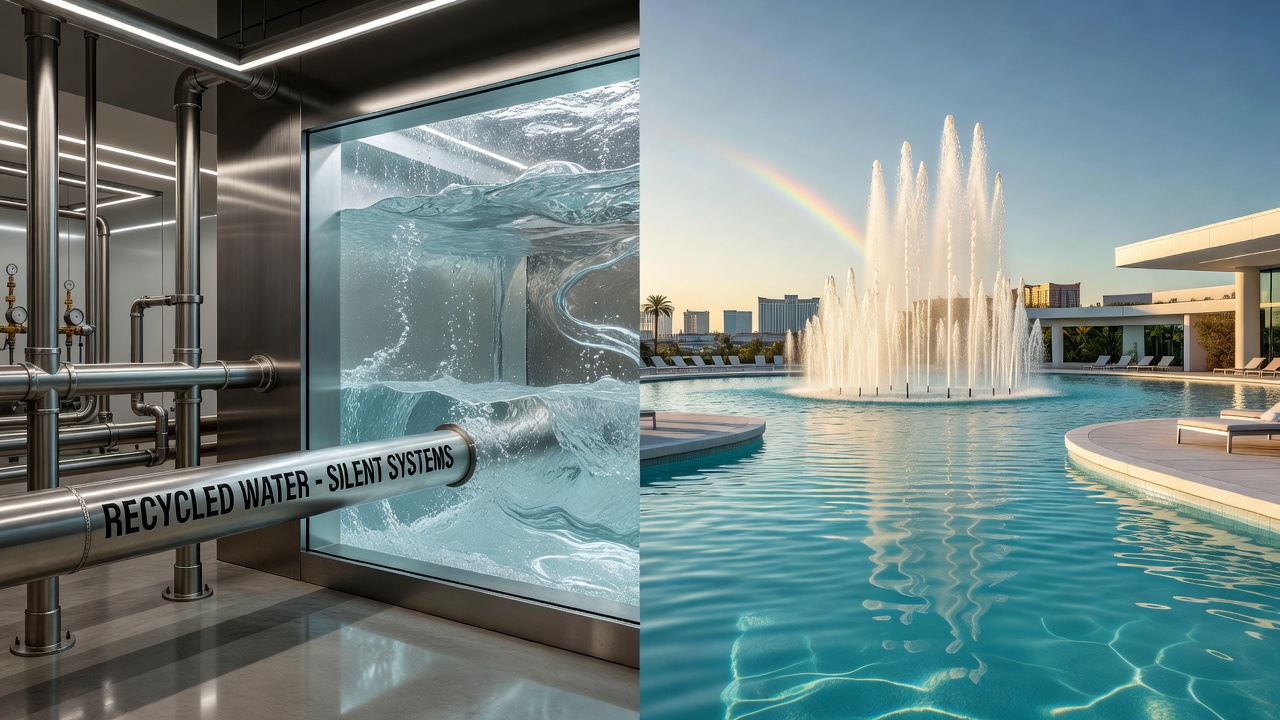
Evaporation remains the primary loss mechanism in open pool and fountain surfaces, and resorts calculate daily makeup volumes using pan-evaporation data correlated with local weather stations. During summer months when surface temperatures exceed 90 degrees Fahrenheit, losses can reach 1 percent of total system volume per day, requiring precise metering of tertiary-treated effluent from municipal reclamation plants. Resorts blend this reclaimed water with on-site recycled streams to maintain consistent mineral profiles, avoiding the scaling issues that arise when hardness levels fluctuate. Cooling towers that serve adjacent HVAC systems sometimes share the same reclaimed source, creating integrated water budgets that optimize allocation across multiple end uses within a single property.
Operational Monitoring and Redundancy Measures
Operators maintain redundant pump stations and backup power feeds so that circulation never stops during maintenance windows or grid disturbances. Flow meters installed at every major loop segment feed data into historian databases that allow engineers to detect gradual efficiency declines, such as membrane fouling indicated by rising differential pressures. When anomalies appear, crews isolate affected trains and divert flow through parallel units until cleaning or cartridge replacement restores design performance. These practices keep total water consumption per occupied room well below national averages for resort properties, according to figures compiled by the Water Research Foundation.
Integration with Broader Regional Conservation Goals
Las Vegas Valley water managers coordinate with individual resorts through the Southern Nevada Water Authority to align property-level recycling with basin-wide conservation targets. Resorts participate in voluntary audits that identify additional recovery opportunities, such as capturing condensate from air-handling units and routing it into fountain feed lines. In parallel, the U.S. Environmental Protection Agency has documented case studies of similar closed-loop systems in other arid regions, providing technical references that local operators adapt to fountain-specific hydraulic demands. These collaborations produce measurable reductions in potable-water withdrawals while preserving the visual and recreational amenities that define the destination.
Conclusion
Resort water recycling programs combine proven mechanical, chemical, and biological treatment steps with continuous digital oversight to sustain large-scale pools and fountains under desert conditions. Regulatory timelines set for 2026 will accelerate adoption of polishing technologies that further reduce discharge and consumption, while ongoing coordination with regional authorities ensures that property-level performance supports broader aquifer protection objectives. The resulting systems operate largely out of sight yet deliver the reliable water quality required for uninterrupted guest experiences throughout the year.